Palworld has nine elements, and each one is strong against one other element, with two exceptions: Fire beats both Grass and Ice, and Neutral beats nothing. The matchups are Water beats Fire, Electric beats Water, Ground beats Electric, Grass beats Ground, Ice beats Dragon, Dragon beats Dark, and Dark beats Neutral. As of the latest update (the most recent patch I found is 1.0.5, from September 15, 2026), current guides show the chart is unchanged since Palworld 1.0 launched on July 10, 2026.
The Full Palworld Type Chart
| Element | Strong Against | Weak To |
|---|---|---|
| Neutral | None | Dark |
| Fire | Grass, Ice | Water |
| Water | Fire | Electric |
| Electric | Water | Ground |
| Ground | Electric | Grass |
| Grass | Ground | Fire |
| Ice | Dragon | Fire |
| Dragon | Dark | Ice |
| Dark | Neutral | Dragon |
Read it two ways. If you want to hit an enemy hard, find the enemy’s element in the “Weak To” column and attack with that. If you want to protect your own Pal, avoid sending it against an element listed in its “Weak To” column.
Palworld Weakness Chart: What to Bring
This is the quick lookup for before a fight:
| Enemy Element | Best Counter |
|---|---|
| Neutral | Dark |
| Fire | Water |
| Water | Electric |
| Electric | Ground |
| Ground | Grass |
| Grass | Fire |
| Ice | Fire |
| Dragon | Ice |
| Dark | Dragon |
Fire shows up twice because it counters two elements. That makes it the most flexible attacking type on the chart.
A Memory Trick for the Whole Chart
You don’t have to memorize nine separate matchups. The chart is a five-element loop with a four-element tail:
- The loop: Water beats Fire, Fire beats Grass, Grass beats Ground, Ground beats Electric, Electric beats Water.
- The tail: Fire beats Ice, Ice beats Dragon, Dragon beats Dark, Dark beats Neutral.
Fire is the connecting point, which is why it’s the only element with two advantages. Once you remember the loop, the tail is just four more links in a row.
How Type Effectiveness Works in Practice
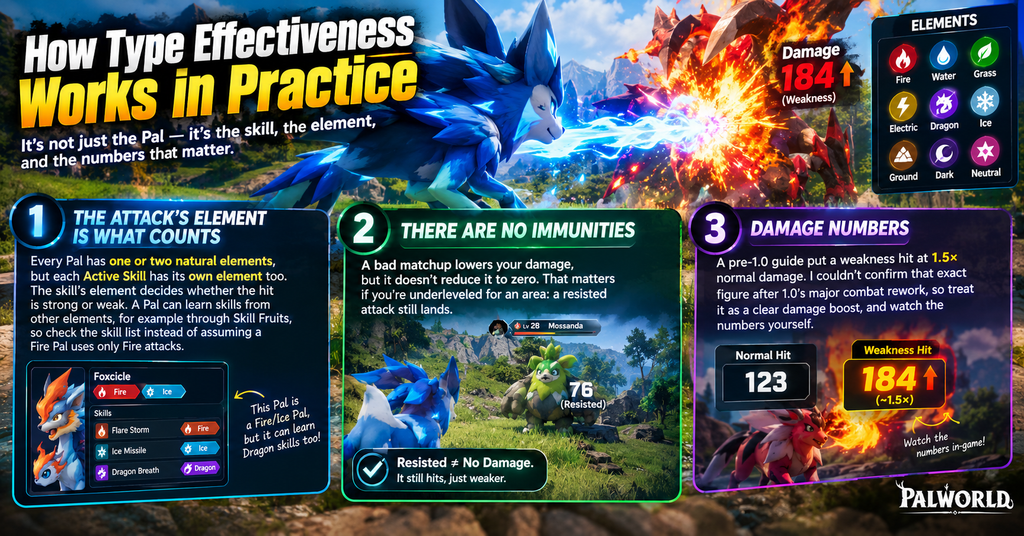
The attack’s element is what counts. Every Pal has one or two natural elements, but each Active Skill has its own element too. The skill’s element is what decides whether the hit is strong or weak. A Pal can learn skills from other elements, for example through Skill Fruits, so check the skill list instead of assuming a Fire Pal uses only Fire attacks.
There are no immunities. A bad matchup lowers your damage, but it doesn’t reduce it to zero. That matters if you’re underleveled for an area: a resisted attack still lands.
Damage numbers. A pre-1.0 guide put a weakness hit at 1.5 times normal damage. I couldn’t confirm that exact figure after 1.0’s major combat rework, so treat it as a clear damage boost, and watch the numbers yourself.
Matching your attack to your Pal’s own element. Before 1.0, a guide reported that attacks matching the user’s own element dealt 20% more damage. As with the 1.5 figure, I couldn’t confirm the number against the current build.
How Dual-Element Pals Work
Some Pals have two elements, such as Penking (Water/Ice) and Jormuntide Ignis (Fire/Dragon). A dual-element Pal can carry the weaknesses and resistances of both elements. Sometimes they stack, and sometimes they offset each other.
Take a Water/Grass Pal as an example. Fire is strong against Grass, but Water is strong against Fire. The two effects can pull in opposite directions, so Fire may not hit as hard as the chart alone suggests.
The practical rule: always read both elements before you pick a counter. Check the Paldeck entry, which shows two icons for a dual-type Pal.
How to Prepare for a Boss or Alpha Pal
- Find the element. Open the Pal’s Paldeck entry or information screen.
- Look up the counter. Use the weakness table above, and check both elements if it has two.
- Check your Active Skills. Make sure at least one of your Pals carries an attack of the counter element.
- Swap your party. Build around the fight instead of bringing the same team everywhere.
- Bring a backup. If the boss has a second element or an unexpected skill set, a second attack type gives you an option.
One example that comes up often is Dragon enemies. Ice is the only direct counter to Dragon, and a Pal like Frostallion is a common choice for those fights, according to one guide. Keeping at least one Ice option on hand is worth the slot.
Where Palworld Differs From Pokémon
Palworld’s chart looks familiar, but it isn’t a copy. A few differences trip people up:
- Grass is not strong against Water. In Palworld, Grass counters Ground, and that’s all.
- Ground isn’t weak to Water or Ice. It’s weak to Grass.
- There’s no immunity. Electric can still damage Ground Pals.
- Neutral is the odd one out. Neutral has no offensive advantage and is only weak to Dark.
Some fan-made type tools list extra matchups, for example Grass beating Water. They don’t match the chart other current guides show. If a tool disagrees with the table above, check against the type chart in the game’s Survival Guide, which is where it lives, based on current information.
Mistakes to Avoid
Trusting a Pal’s natural element for its attacks. A Fire Pal with a Water skill equipped is not hitting for Fire damage.
Reading only one element on a dual-type enemy. You may bring a counter that’s partly cancelled by the other element.
Relying on levels alone. A high-level Pal with a poor matchup can still struggle against a strong enemy.
Using the Pokémon chart from memory. Several matchups look similar but don’t match.
Stacking one element. A team of all Fire Pals is strong against Grass and Ice and weak to Water. Spread your coverage.
Which Elements Should You Keep on Your Team?
There’s no single best element, but a spread covers most situations. A sensible set to have access to:
- Fire for Grass and Ice enemies
- Water for Fire enemies
- Electric or Ground for Water or Electric enemies
- Ice for Dragon enemies
- Dragon or Dark for Dark or Neutral enemies
You don’t need nine Pals for that. Skill Fruits let a Pal carry attacks from other elements, so a small team can cover several types.
Conclusion
The Palworld type chart is nine elements with a simple pattern: a five-element loop (Water, Fire, Grass, Ground, Electric) and a four-element tail (Fire, Ice, Dragon, Dark, Neutral). Check the enemy’s element or elements, then bring an attack of the counter element. The attack’s own element is what matters, so check your Active Skills as well as your Pals.
FAQs
How many elements are there in Palworld?
Nine: Neutral, Fire, Water, Grass, Electric, Ground, Ice, Dragon, and Dark.
What beats Dragon in Palworld?
Ice. It’s the only element that’s strong against Dragon.
What is Fire weak to?
Water. Fire is strong against both Grass and Ice.
What is Neutral weak to?
Dark. Neutral has no strengths of its own.
Did Palworld 1.0 change the type chart?
Based on current information, no. A guide updated on September 16, 2026 still shows nine elements and the same matchups, though 1.0 did rework Active Skills and combat in other ways.
Can I attack an enemy with a different element than my Pal?
Yes. Active Skills have their own elements, and the skill’s element decides the matchup.
For more updates visit: GAME SPEC