

Cobblemon is the better pick for most players in 2026. It’s lightweight, blends into vanilla Minecraft’s art style, and runs comfortably on modest server hardware. Pixelmon still wins if you want the most complete Pokémon roster, HD models, and a classic mainline-style battle system, but it demands significantly more RAM to run well.
What Each Mod Actually Is
Pixelmon is the older of the two, first bringing Pokémon into Minecraft years before Cobblemon existed. The original Pixelmon Mod stopped development, so today’s players use forks like Pixelmon Reforged or Pixelmon Generations to keep playing. Based on current information, active Pixelmon builds run on Minecraft 1.21.1 using NeoForge.
Cobblemon launched in November 2022 as an open-source alternative and has grown fast since. It now sits at over 25 million downloads on CurseForge, and as of the latest update, its official wiki highlights version 1.7.0. Being open source means more contributors, which translates to faster patches and quicker bug fixes than Pixelmon’s slower, more centralized development pace.
Pixelmon vs Cobblemon: Core Differences
The two mods take genuinely different approaches, not just different art styles.
Art style > Cobblemon’s Pokémon are blocky and pixelated, built to look like they belong in Minecraft’s world. A Charizard here looks like a Minecraft mob. Pixelmon goes the opposite direction, using detailed 3D HD models that look closer to the mainline Pokémon games.
Pokémon roster > Pixelmon currently has the numbers advantage, with reports of over 1,000 Pokémon across all nine generations, including regional variants and Mega Evolutions. Cobblemon sits at 700+ species and is adding more with each update, so this gap is narrowing over time rather than staying fixed.
Gameplay focus > Cobblemon keeps Minecraft’s sandbox loop front and center. You can mine, build, and fight regular mobs while still catching and battling Pokémon, since Pokémon spawn naturally across biomes rather than replacing the core survival experience. Pixelmon leans harder into RPG-style Pokémon progression, with deeper battle systems and more Pokémon-specific content layered on top of Minecraft.
Server performance > This is where the gap is largest. Cobblemon packs often run fine on 4 to 8 GB of RAM. Pixelmon, because of its HD models and heavier systems, often needs 10 to 12 GB to run smoothly. On a typical budget hosting tier, that difference can add several dollars to your monthly server cost.
Mod compatibility > Cobblemon supports both Fabric and NeoForge, giving you more flexibility when building a modpack. Pixelmon currently runs on NeoForge for Minecraft 1.21.1.
Battle System and In-Game Feel
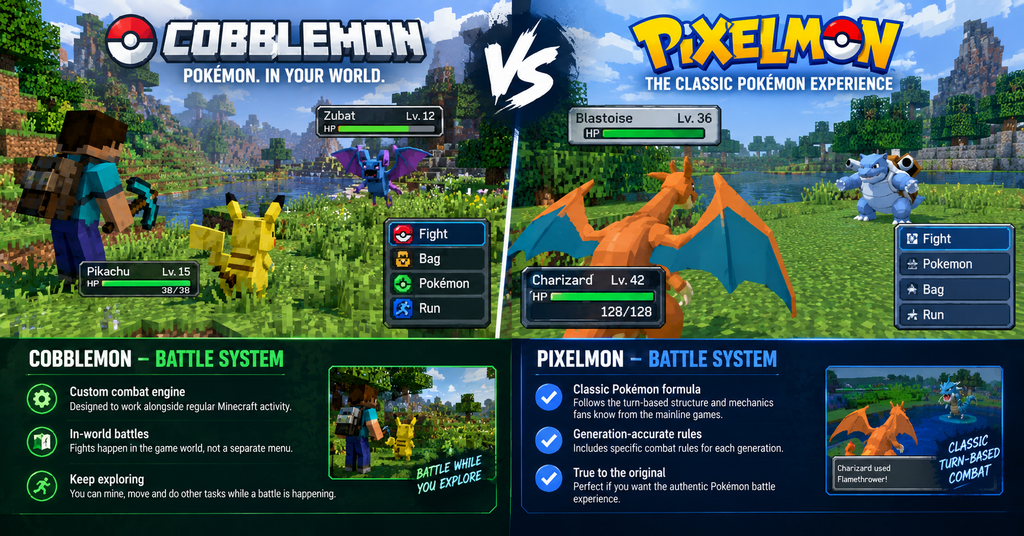
The battle systems reflect each mod’s overall philosophy. Cobblemon uses a custom combat engine built to coexist with regular Minecraft activity, so you’re not locked into a separate menu-driven screen the way you are in mainline Pokémon games. Fights happen in the world itself, and you can technically keep mining or moving while a battle plays out nearby.
Pixelmon’s battle system follows the classic Pokémon formula more closely, aiming to mirror the turn-based structure and mechanics fans know from the mainline games, including specific Generation-accurate combat rules. If part of the appeal for you is nostalgia for exact-feeling Pokémon battles, Pixelmon delivers that more faithfully. If you’d rather battles feel like a natural extension of Minecraft survival rather than a separate mode, Cobblemon fits better.
Modpacks and Add-Ons
Neither mod exists in isolation once you start building a server, and the add-on ecosystem differs quite a bit between the two.
Cobblemon’s open-source nature means community add-ons come out fast, covering things like gym systems, raid battles, trading hubs, and economy plugins. Because Cobblemon is built to be lightweight by design, most of these add-ons stack on top without pushing server requirements too high, which keeps the total RAM footprint manageable even with several add-ons installed.
Pixelmon, by contrast, already ships with more built-in systems out of the box, so there’s less need to bolt on extra add-ons for things like gyms or trading, those are typically already part of the base mod. The tradeoff is that this content comes pre-loaded into the resource cost, so you’re paying the RAM cost whether or not you use every system it includes.
If you’re planning to run a heavily customized server with a specific theme or ruleset, Cobblemon’s modular approach generally gives you more control over exactly what you’re running. If you want a complete package without assembling pieces yourself, Pixelmon’s all-in-one design saves setup time.
Which One Should You Actually Pick
If you’re new to Pokémon mods or building a modpack from scratch, Cobblemon is the easier starting point. It installs cleanly, plays well with other mods, and won’t strain a budget server. Its open-source nature also means community-made add-ons for gyms, raids, and trading are easier to find and integrate.
Pick Pixelmon if your priority is having every Pokémon and mechanic possible in one package, or if you’re joining an existing Pixelmon community that’s already built around it. It remains the more complete, mainline-faithful experience for players who want to sink hundreds of hours into deep Pokémon-specific systems without assembling that experience themselves.
If your community is already active on one mod, that’s often the deciding factor over any feature comparison. Switching an established Pixelmon server to Cobblemon means losing progress and rebuilding player bases from scratch, which usually isn’t worth it just for better performance.
A Common Mistake When Choosing
Many players assume both mods offer roughly the same experience with different graphics, then pick based on looks alone. That’s a mistake. The gameplay loop is genuinely different: Cobblemon keeps you doing normal Minecraft things between Pokémon encounters, while Pixelmon shifts the game further toward a dedicated Pokémon RPG. Test both on a low-stakes single-player world before committing a whole server to one or the other, since the “feel” difference matters more than the spec sheet.
Another mistake worth flagging: assuming server RAM requirements are fixed numbers rather than starting points. Both figures (4-8 GB for Cobblemon, 10-12 GB for Pixelmon) shift based on player count, installed add-ons, and world size. Budget a little above the minimum rather than right at it, especially if you expect your server to grow.
Conclusion
Cobblemon suits most players heading into 2026, thanks to its lighter footprint, vanilla-friendly style, and faster update pace. Pixelmon still holds the edge in raw content and roster size for players who want the deepest possible Pokémon experience and have the server resources to support it. The right choice comes down to whether you value performance and simplicity, or maximum content and classic-style battles.
FAQs
Is Cobblemon or Pixelmon better for a low-budget server?
Cobblemon, by a clear margin. It typically runs on 4 to 8 GB of RAM, while Pixelmon often needs 10 to 12 GB to perform well, which affects your hosting costs directly.
Does Pixelmon or Cobblemon have more Pokémon?
Pixelmon currently has more, with reports of over 1,000 species including regional forms and Mega Evolutions. Cobblemon has 700+ and continues adding more with each update, based on current information.
Can I switch my server from Pixelmon to Cobblemon later?
Technically, but it means starting over. Player data, progress, and world setups don’t transfer between the two mods, so switching usually means rebuilding your community from scratch.
Which mod updates faster?
Cobblemon, as of the latest update. Its open-source structure means patches and new Pokémon come from a larger pool of contributors, while Pixelmon’s development moves at a slower, more centralized pace.
Do both mods work with the same Minecraft version?
Based on current information, active Pixelmon builds run on Minecraft 1.21.1 via NeoForge. Cobblemon supports both Fabric and NeoForge, giving it broader compatibility across modpack setups.
For more updates visit: GAME SPEC