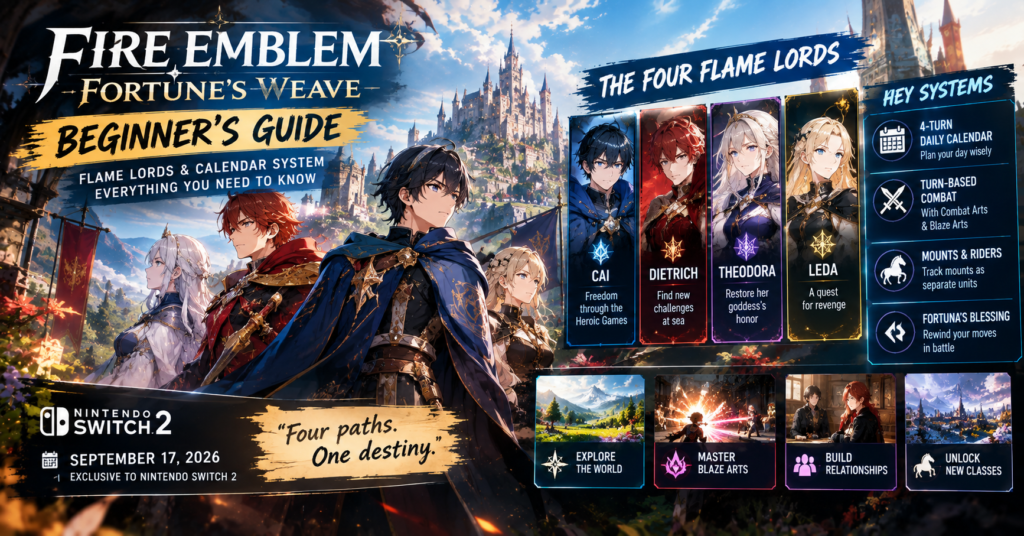

Fire Emblem Fortune’s Weave changes how the series works with a new calendar system, splitting its story across four playable Flame Lords: Cai, Dietrich, Theodora, and Leda. Cai is the most beginner-friendly starting point, since his story introduces the game’s core systems, the Heroic Games, the four-turn daily calendar, and Blaze Arts, without the heavier political threads that Theodora’s or Leda’s routes carry. This guide covers the release details, what’s changed since Three Houses, how the calendar works, and where new players tend to lose time without realizing it.
Release Date & Platform
Fire Emblem Fortune’s Weave released on September 17, 2026, exclusively for Nintendo Switch 2. There’s no version for the original Nintendo Switch. Intelligent Systems developed the game, Nintendo published it, and it stands as the eighteenth mainline entry in the series.
What’s New vs. Three Houses
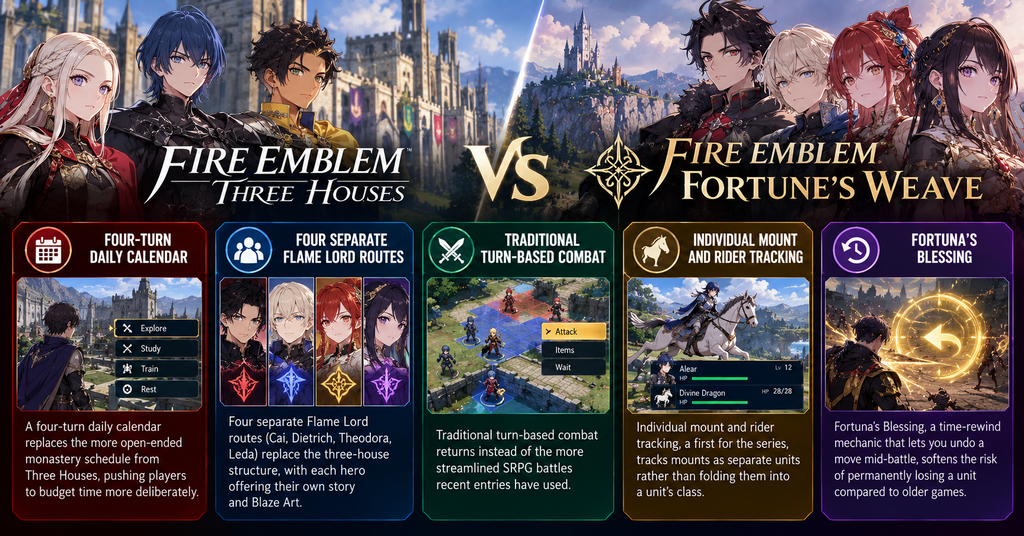
Fortune’s Weave builds on Three Houses’ foundation but shifts several core systems:
- A four-turn daily calendar replaces the more open-ended monastery schedule from Three Houses, pushing players to budget time more deliberately.
- Four separate Flame Lord routes (Cai, Dietrich, Theodora, Leda) replace the three-house structure, with each hero offering their own story and Blaze Art.
- Traditional turn-based combat returns instead of the more streamlined SRPG battles recent entries have used.
- Individual mount and rider tracking, a first for the series, tracks mounts as separate units rather than folding them into a unit’s class.
- Fortuna’s Blessing, a time-rewind mechanic that lets you undo a move mid-battle, softens the risk of permanently losing a unit compared to older games.
What Fortune’s Weave Is About
The story opens five years after the Heroic Games, in the year 1454, with the Dagdan Empire facing ruin at the hands of a revived demon god named Balor. The four heroes who once competed in those games have vanished. Sothis, the same god familiar to Three Houses players, sends down a soul, your customizable protagonist, to fix things.
Rather than fighting Balor directly, the time-traveling goddess Fortuna offers another route: go back to the Heroic Games era and walk in the shoes of Cai, Dietrich, Theodora, or Leda, changing their fates before bringing them forward to the final battle. You can play each Hero’s story in parallel, then travel through time again afterward to try a different path if you want to see how it changes the narrative.
How the Daily Calendar Works
This is the system that catches new players off guard the most. Each day inside Dagsion, the empire’s capital, splits into four separate turns. How you spend them determines what you’re able to do before the story’s next deadline arrives, which can be as close as a week out or as far as several months away.
Your options each turn generally break down into a few categories:
- Exploring the World Map — visiting towns, gathering information, and triggering random Skirmishes, though every move here costs time.
- Dungeon Delving — collecting materials and treasure through turn-based Clashes that play differently from story battles.
- Training — improving abilities and unlocking access to new classes as your characters grow stronger.
- Building Relationships — recruiting new allies in Dagsion through gifts or shared meals, similar to the social systems in Three Houses.
Because every action eats into a limited pool of turns, the calendar effectively forces you to prioritize. Spend too many turns exploring early on, and you’ll have less time left for training before a major story battle arrives.
Turn-Based Combat and Blaze Arts
Combat itself moves away from the streamlined SRPG battles recent Fire Emblem entries have used, going back to a more traditional turn-based structure. Weapons remain familiar: swords, lances, axes, bows, gauntlets, and magic all return, and magic now covers both offensive and support functions, including healing, a shift from earlier games that relied on separate staves.
Combat Arts return from Three Houses, letting you spend weapon durability for stronger attacks, longer range, or other situational effects. Blaze Arts sit above that as more powerful abilities tied specifically to your Flame Lord, costing a chunk of their HP rather than weapon durability, so they’re built for turning a losing fight around rather than routine use.
A returning mechanic called Fortuna’s Blessing lets you rewind to any earlier point in a battle after making a move. This effectively removes most of the punishment for a bad tactical call or a unit getting routed unexpectedly, which matters if you’re used to permadeath tension from older entries in the series.
Mounts and Riders
A first for the series, mounts and riders are tracked separately as individual units rather than a mount simply being part of a character’s class. Classes span three tiers, Beginner, Specialty, and Advanced, with five Beginner classes available at the start, including gladiators, diviners, and ornius riders. Specialty classes add over ten new options like armored knights and charioteers, while Advanced classes include cataphracts, guardians, and elephant riders.
The Four Flame Lords Compared
Each Flame Lord has a distinct starting motivation, a unique Blaze Art, and a talent that affects what they’re best at outside of battle.
| Flame Lord | Motivation | Blaze Art | Talent | Best For |
|---|---|---|---|---|
| Cai | Frees his imprisoned father by winning the Heroic Games | Wide-area fireball that hits every enemy in range | Captures animals while exploring | First-time players |
| Dietrich | Shipwrecked on Dagda’s shores, seeks stronger opponents | Warps to otherwise unreachable parts of the battlefield | Sniffs out hidden enemy groups | Mobility-focused, aggressive players |
| Theodora | Leads veteran retainers to restore her goddess’s honor | Conjures boulders from the ground to fling at range | Recruits soldiers to gather materials | Players who enjoy political stakes |
| Leda | Hunts her father’s murderer, who enters the games too | Plays her instrument to buff allies and summon a monster | Performs for materials while exploring | Players who want a revenge-driven story |
Which Flame Lord Should You Start With?
If you’re picking your first route in Fire Emblem Fortune’s Weave, Cai’s story is the gentlest entry point. His personal stakes, freeing his father, are simple to follow, and his Blaze Art’s wide-area hit makes him forgiving in group fights while you’re still learning positioning and the calendar system. His animal-capture talent also nudges you toward exploring the World Map early, which helps you learn that system without much risk.
Dietrich works well as a second route if you enjoy more aggressive, mobility-focused play, since his warp-based Blaze Art rewards planning around terrain rather than brute force. Theodora and Leda both carry heavier narrative stakes tied to political intrigue and revenge respectively, which land better once you already understand the core systems from an earlier route.
Since Fortune’s Weave lets you play routes in parallel or revisit them later through time travel, there’s no wrong permanent choice here. Starting with Cai simply front-loads the easier systems before you tackle the routes with denser plotting.
Common Mistakes New Players Make
New players tend to overspend turns exploring in the early calendar cycles, since the World Map is immediately available and tempting to fully clear. This leaves fewer turns for training right before a major story battle, where your characters may arrive underleveled. Budget at least one or two turns per cycle for training once you’re a few story chapters in, rather than treating exploration as the default use of every turn.
Another common misstep is holding onto Blaze Arts too cautiously. Because they cost HP rather than an easily replenished resource, some players avoid using them almost entirely. Since Fortuna’s Blessing lets you rewind mistakes anyway, there’s little reason to hoard a Blaze Art past the point where it could turn a fight in your favor.
Reviewers have also flagged that reaching full completion is a slog given the game’s scale, so if your goal is just finishing the main story rather than 100%, don’t feel obligated to fully clear every dungeon or Skirmish the World Map offers.
Conclusion
Fire Emblem Fortune’s Weave layers a four-turn daily calendar, traditional turn-based combat, and four distinct Flame Lord routes on top of systems familiar from Three Houses. Cai’s route offers the smoothest introduction to all of it, while Dietrich, Theodora, and Leda each bring their own combat style and narrative tone once you’re past the basics. Since every route stays accessible through time travel, there’s no pressure to pick perfectly on your first playthrough, just a smoother one if you start with Cai.
FAQs
Which Flame Lord is best for beginners in Fortune’s Weave?
Cai is generally the easiest starting point. His story introduces core systems gradually, and his wide-area Blaze Art is forgiving for players still learning positioning.
Can I play more than one Flame Lord’s story?
Yes. You can play each Hero’s story in parallel, and time travel later lets you revisit a different path if you want to see how the narrative changes.
How does the four-turn calendar affect gameplay?
Each day gives you four turns to spend on exploring, training, dungeon delving, or building relationships. Since story deadlines are fixed, overspending turns on one activity can leave you underprepared for the next major battle.
What’s the difference between Combat Arts and Blaze Arts?
Combat Arts cost weapon durability and offer combat bonuses like extra range or power. Blaze Arts cost a Flame Lord’s HP and are more powerful, hero-specific abilities meant for turning fights around rather than routine use.
Does Fortune’s Weave still have permadeath?
Fortuna’s Blessing lets you rewind to any earlier point in a battle after making a move, which significantly softens the risk of losing a unit permanently compared to earlier entries in the series.
For more updates visit: GAME SPEC