
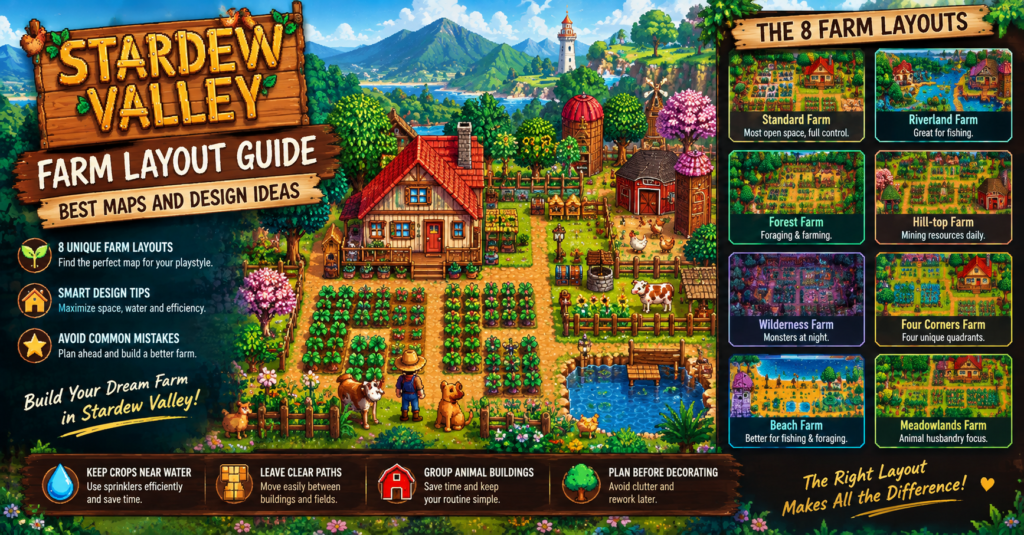

The best Stardew Valley farm layout is one that maximizes sprinkler efficiency, movement speed, and clear zoning. For most players, Standard Farm or Four Corners Farm offers the most flexibility, while strong layouts use 5×5 Iridium sprinkler grids, grouped buildings, and separate areas for crops, animals, and production.
What a Good Stardew Valley Farm Layout Actually Means
A good farm layout isn’t about decoration > it’s about saving time every single in-game day.
You only have limited hours each day, so your layout directly affects:
- How fast you harvest crops
- How quickly you handle animals
- How much time you waste walking
The goal is simple:
👉 Do more in less time
That’s why strong layouts always focus on:
- Tight crop grids
- Short travel paths
- Organized zones
If your farm feels slow to manage, it’s usually a layout problem.
The 8 Stardew Valley Farm Layouts Explained
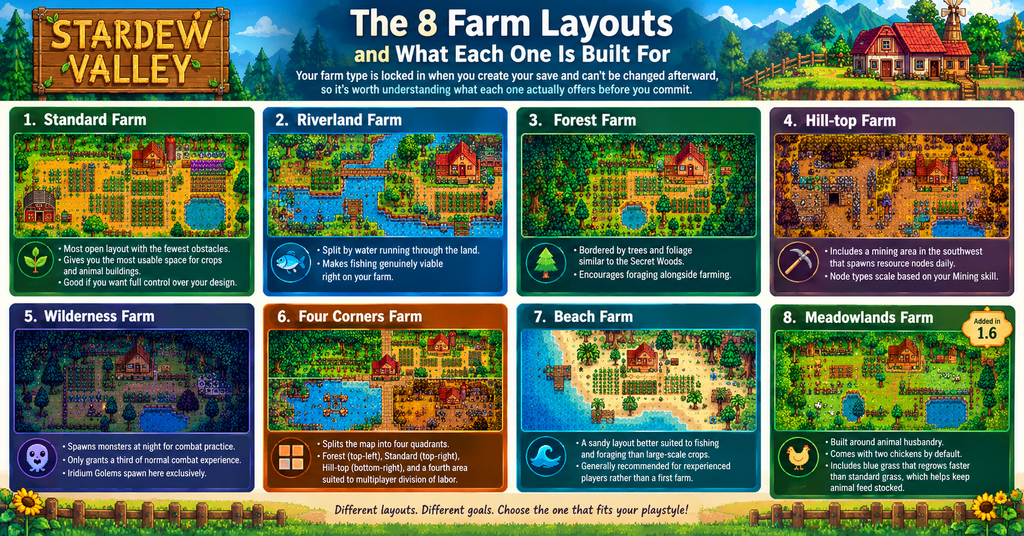
You choose your farm at the start, and it cannot be changed later. Here’s how each one actually plays:
- Standard Farm > Best all-round layout. Maximum open space for crops and buildings.
- Riverland Farm > Heavy water layout. Good for fishing, weak for farming space.
- Forest Farm > Extra forageables and hardwood. Good early-game resource boost.
- Hill-top Farm > Includes a mining area with ore spawns. Less space for crops.
- Wilderness Farm > Monsters spawn at night. Useful for combat farming.
- Four Corners Farm > Divided into sections. Excellent for organized builds or multiplayer.
- Beach Farm > Limited sprinkler use. Better for fishing-focused play.
- Meadowlands Farm (1.6) > Designed for animals, includes blue grass and starting chickens.
👉 If your goal is efficiency:
Standard or Four Corners are the safest picks
How to Design Your Farm Layout (Core Principles)
1. Build Around Sprinkler Grids
Late-game farming depends on Iridium Sprinklers, which water a 5×5 area.
Best approach:
- Build crops in square blocks
- Align everything to the sprinkler radius
- Avoid random placement
👉 Example:
A 5×5 grid around each sprinkler lets you scale crops cleanly without gaps.
This alone massively improves efficiency.
2. Keep Travel Distance Low
Every extra step costs time.
Good layouts:
- Keep crops close to your house
- Place barns and coops together
- Avoid spreading buildings across the map
Bad layouts:
- Force you to run back and forth all day
👉 If you’re constantly running, your layout is wrong.
3. Divide Your Farm Into Zones
Instead of mixing everything, split your farm into clear areas:
- Crop zone
- Animal zone
- Tree/orchard area
- Processing zone (kegs, furnaces, etc.)
This makes your farm:
- Easier to manage
- Faster to navigate
- Easier to expand later
Best Stardew Valley Farm Layout Ideas (That Actually Work)
This is where most guides fall short > real usable layouts.
Early Game Layout (Spring Year 1)
Focus on:
- Simplicity
- Fast access
- Low cost
Setup:
- Small crop patch near house
- One storage area (chests)
- Clear walking space
Avoid:
- Overbuilding
- Decorating early
👉 You will rebuild later anyway.
Mid Game Layout (First Sprinklers + Animals)
This is where your real layout starts forming.
Add:
- Quality Sprinkler crop grids
- Dedicated animal area (coops + barns together)
- Basic fencing
Start organizing:
- Crops in one area
- Animals in another
👉 This stage sets up your late-game efficiency.
Late Game Layout (Iridium Sprinklers + Automation)
This is your final optimized layout.
Strong structure:
- Multiple 5×5 sprinkler grids placed side-by-side
- Large crop blocks with clear paths between them
- Animals grouped into one section
- Processing area near farmhouse
Example layout idea:
- Top area → crops (sprinkler grids)
- Side area → barns and coops
- Bottom → kegs, furnaces, machines
- Separate rows → fruit trees
👉 Everything has a purpose. Nothing is random.
Practical Farm Design Tips That Save Time
Use Paths to Control Movement
Paths:
- Keep layout clean
- Prevent accidental crop damage
- Make navigation faster
Even simple dirt or stone paths help a lot.
Keep Animals in One Area
Morning routine becomes faster if:
- Coops and barns are grouped
- Silos are nearby
👉 Don’t spread animals across the map.
Use the Greenhouse Efficiently
Once unlocked:
- Treat it as a high-value farming zone
- Use tight crop grids with sprinklers
Best use:
- High-profit crops that regrow
Place Machines Near Your Route
Kegs, furnaces, and machines should be:
- Near your main walking path
- Not hidden in corners
👉 You should naturally pass them during daily tasks.
Common Stardew Valley Farm Layout Mistakes
1. Random Crop Placement
This kills efficiency:
- Wastes sprinkler coverage
- Slows harvesting
2. Ignoring Map Limitations
Examples:
- Beach Farm → sprinklers don’t work on sand
- Hill-top → mining area blocks space
👉 Always design around your map.
3. Overdecorating Too Early
Looks good, but:
- You’ll move everything later
- It wastes time early
👉 Build function first, design later.
4. Poor Zoning
Mixing crops, animals, and machines:
- Creates confusion
- Slows everything down
5. Not Rebuilding Mid-Game
A lot of players:
- Stick with their early layout too long
👉 Good players redesign their farm as they progress.
Which Stardew Valley Farm Layout Should You Choose?
Here’s the quick breakdown:
- Best overall: Standard Farm
- Best for organization: Four Corners
- Best for animals: Meadowlands
- Best for resources: Forest
- Best challenge: Beach
👉 If unsure → go Standard. It gives full control.
Conclusion
The best Stardew Valley farm layout is built around efficiency, not appearance. Use sprinkler-based crop grids, keep movement simple, and divide your farm into clear zones. Start small, organize during mid-game, and fully optimize in late-game with structured layouts. If your farm saves time, it’s working.
FAQs
Can you change your farm layout later?
No. Your farm type is locked at the start of the game.
What is the best farm layout for beginners?
Standard Farm is the easiest and most flexible option.
What’s the best layout for making money?
Large sprinkler-based crop grids combined with greenhouse farming.
Is Meadowlands Farm good?
Yes, but mainly for animals. It’s not ideal for large crop farming.
What’s the hardest farm layout?
Beach Farm, because sprinklers don’t work on most sand tiles.
When should I redesign my farm?
Mid-game is the best time, once you unlock sprinklers and animals.
For more updates visit: GAME SPEC



Pingback: Dinkum Spooky Event 2026: Bats, Ghoul Drops, Rewards